How to Pose Naturally for Couples Photos
The most memorable couple portraits rarely look posed. They look like a private exchange: a hand finding the other, a quiet laugh after a whisper, the moment you realize you are finally alone together on a very full wedding day. Learning how to pose naturally for couples photos is less about memorizing positions and more about creating enough comfort and connection for your real relationship to come through.
For couples planning a wedding in Washington, DC, Northern Virginia, or Maryland, that distinction matters. A polished portrait should feel worthy of the setting and the occasion, but it should still look unmistakably like you. The goal is not to perform romance for the camera. It is to give the camera something genuine to preserve.
Natural Posing Starts Before the Camera Comes Up
Many people worry that they are not photogenic when what they really mean is that they have never been professionally directed. Even highly confident people can feel uncertain when asked what to do with their hands, where to look, or how close to stand. That is normal, and an experienced photographer anticipates it.
The best portraits begin with a simple reset: slow down, stand close, and let your attention return to your partner rather than the lens. A good photographer will offer clear, low-pressure direction, then step back enough to allow an interaction to unfold. This balance is especially valuable on a wedding day, when emotions are high and the schedule is moving quickly.
Comfort also comes from preparation. Choose attire that allows you to move, sit, embrace, and walk without constant adjustment. If one person feels restricted by a jacket, dress, shoes, or hairstyle, it can show in their posture. During a first look, engagement session, or portrait window between ceremony and reception, leave a few extra minutes in the timeline. Rushing is one of the quickest ways to make photographs feel tense.
How to Pose Naturally for Couples Photos
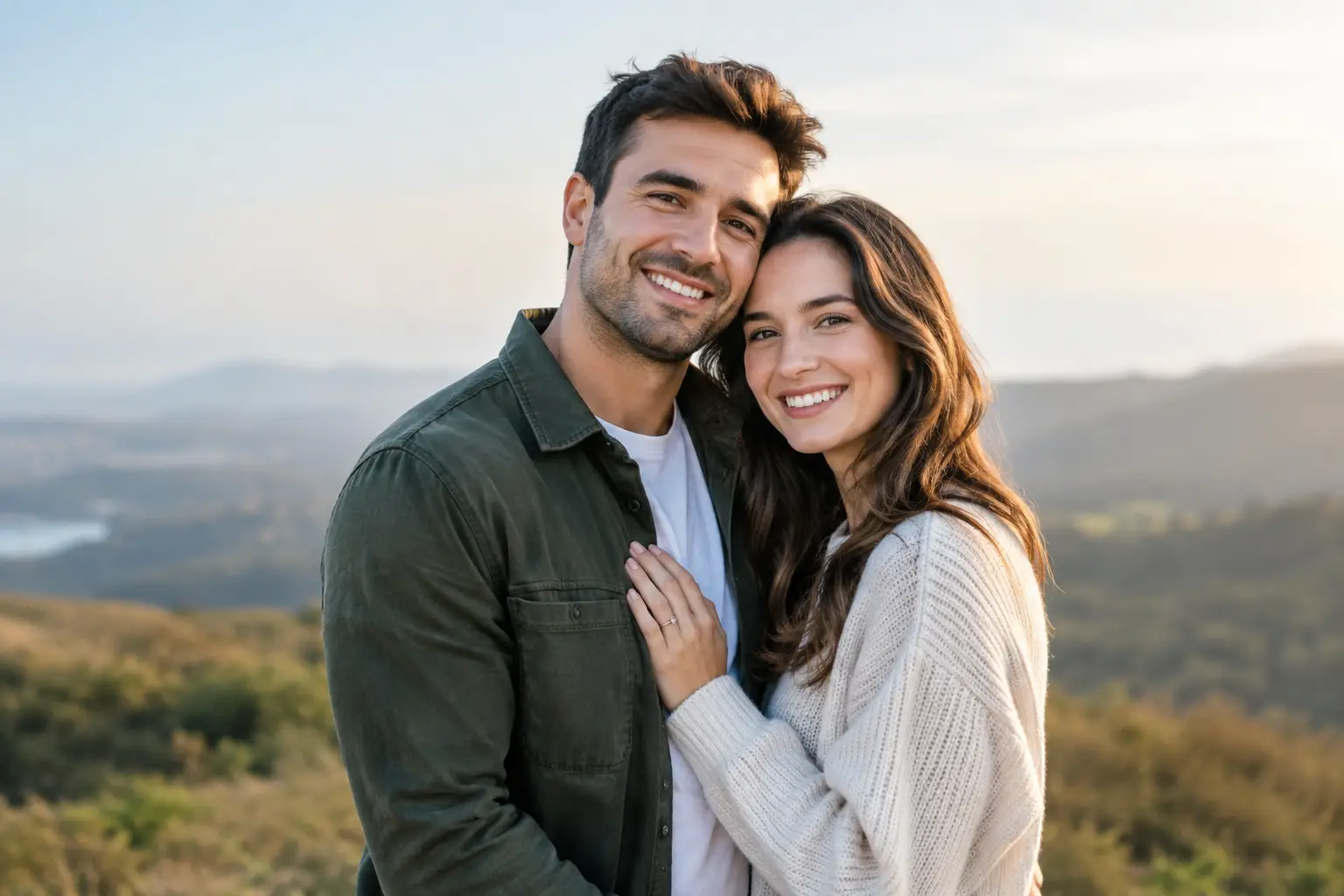
A natural pose is usually built from movement, not stillness. Rather than standing squarely beside one another and smiling on command, begin with a relaxed position that gives your bodies a reason to connect. Turn slightly toward each other, bring your weight onto one leg, and close the space between you. Your shoulders do not need to match, and your expressions do not need to be identical.
The small details create the feeling of ease. One partner might place a hand at the other’s waist while the other rests a hand on a lapel, arm, or shoulder. Your heads can lean together without touching, or you can look at one another for a moment before looking toward the camera. The key is to avoid holding a position so tightly that it stops feeling human.
A photographer may ask you to walk slowly, then glance at each other. You may be invited to bring your foreheads close, take three steps away and come back together, or tell your partner something that will make them laugh. These are not tricks. They are prompts designed to create a real response rather than a fixed expression.
If a prompt feels unnatural to you, say so. The strongest portrait experience is collaborative. Some couples are openly affectionate and playful; others are quieter and more reserved. Neither approach is more photogenic. Your photographer should adapt the direction to the way you naturally show affection, whether that is a full embrace, a shared smile, or simply holding hands.
Let Your Hands Have a Purpose
Hands are often the source of portrait anxiety because they become noticeable when they are left unsupported. Give them a simple job. Hold your partner’s hand, adjust a cuff, rest a palm at the waist, or touch the edge of a bouquet. Gentle contact reads beautifully in photographs because it communicates closeness without requiring a dramatic pose.
Avoid pressing hands flat against your body or gripping too tightly. Think of the contact as light and intentional. For wedding portraits, the hand that displays a ring can be placed naturally where it remains visible, but it should not become the entire pose. A ring is part of the story, not the story itself.
Use Your Eyes to Change the Image
You do not need to look at the camera in every frame. In fact, a varied gallery feels more personal when some photographs are about the connection between the two of you. Look at your partner’s eyes, their cheek, or down toward your joined hands. Close your eyes briefly during an embrace. Let a laugh finish before resetting.
When you do look at the camera, take a breath first. A relaxed face photographs differently from a forced smile. Think of the lens as a person you trust rather than an object demanding a perfect expression. One calm, confident look can become a classic portrait, especially when surrounded by more candid, emotional frames.
Flattering Angles Without Feeling Stiff
Natural does not mean unconsidered. A photographer pays attention to light, background, posture, and how each person is positioned so the image feels refined as well as authentic. Small adjustments can make a significant difference: turning your torso slightly instead of facing forward, lengthening through your spine, and lowering your shoulders away from your ears.
Height differences should be treated as an advantage rather than a problem. A taller partner may soften one knee or angle in slightly. A shorter partner may stand on a subtle rise, step closer, or turn toward the taller partner. The objective is not perfect symmetry. It is a composition that feels balanced and affectionate.
The setting also influences the pose. At a grand DC venue, architecture may call for a composed, editorial portrait with clean lines and elegant posture. In a garden, on a Georgetown street, or beneath soft evening light, movement may feel more appropriate. The most successful galleries include both: a few timeless portraits for the frame and many unscripted moments that return you to the feeling of the day.
Trust the Pause Between Directions
Some of the best images happen after you believe the pose is over. You may relax, reach for each other, smooth a jacket, or exchange a quick comment. Those transitions are rich with expression because you are no longer trying to get the photograph right.
That is why experienced wedding photography is not about placing couples into a long sequence of complicated poses. It is about reading the moment, noticing where the light is strongest, and offering just enough guidance to keep you comfortable. With more than three decades of experience documenting celebrations, Rodney Bailey Photography approaches portraiture as part of the day’s larger story, not a disruption from it.
Make Room for the Portraits You Want
If classic portraits matter to you, communicate that early. If you prefer candid images and only a handful of directed photographs, communicate that too. A thoughtful photography plan can honor family formals, preserve the elegance of your venue, and still protect time for relaxed portraits that do not feel rushed or repetitive.
For an engagement session, consider choosing a location with personal meaning rather than selecting a backdrop solely because it is popular. Familiar places often make it easier to settle in. For wedding-day portraits, ask your photographer where the best natural light will be at the time you are scheduled to step away. A small amount of planning gives spontaneity room to happen.
When the camera is in front of you, return to one simple idea: you do not have to impress anyone. Stand close, breathe, and pay attention to the person you chose. The most enduring photograph may arrive in the quiet second after the direction ends, when you forget about posing altogether.
Related Posts