Can You Have Two Photographers at Your Wedding?
A lot of couples ask this after they fall in love with one photographer’s style, then realize a family friend also wants to shoot, or a planner suggests adding more coverage. So, can you have two photographers at your wedding? Yes, absolutely – but whether you should depends on who those photographers are, how they work together, and what kind of experience you want on the day.
This is one of those wedding questions where the legal answer is easy and the practical answer is more nuanced. In most cases, venues will allow multiple photographers, and many professional studios regularly work with a second shooter as part of the coverage. The issue is not whether two cameras can be present. The issue is whether two photographers will help tell your story more completely or make the day feel more crowded, less efficient, and less consistent.
When two photographers at your wedding make sense
For many weddings, two photographers are not just helpful – they are the best way to document the day well. If each photographer has a clearly defined role, the result can be more complete storytelling and better coverage of the moments that matter most.
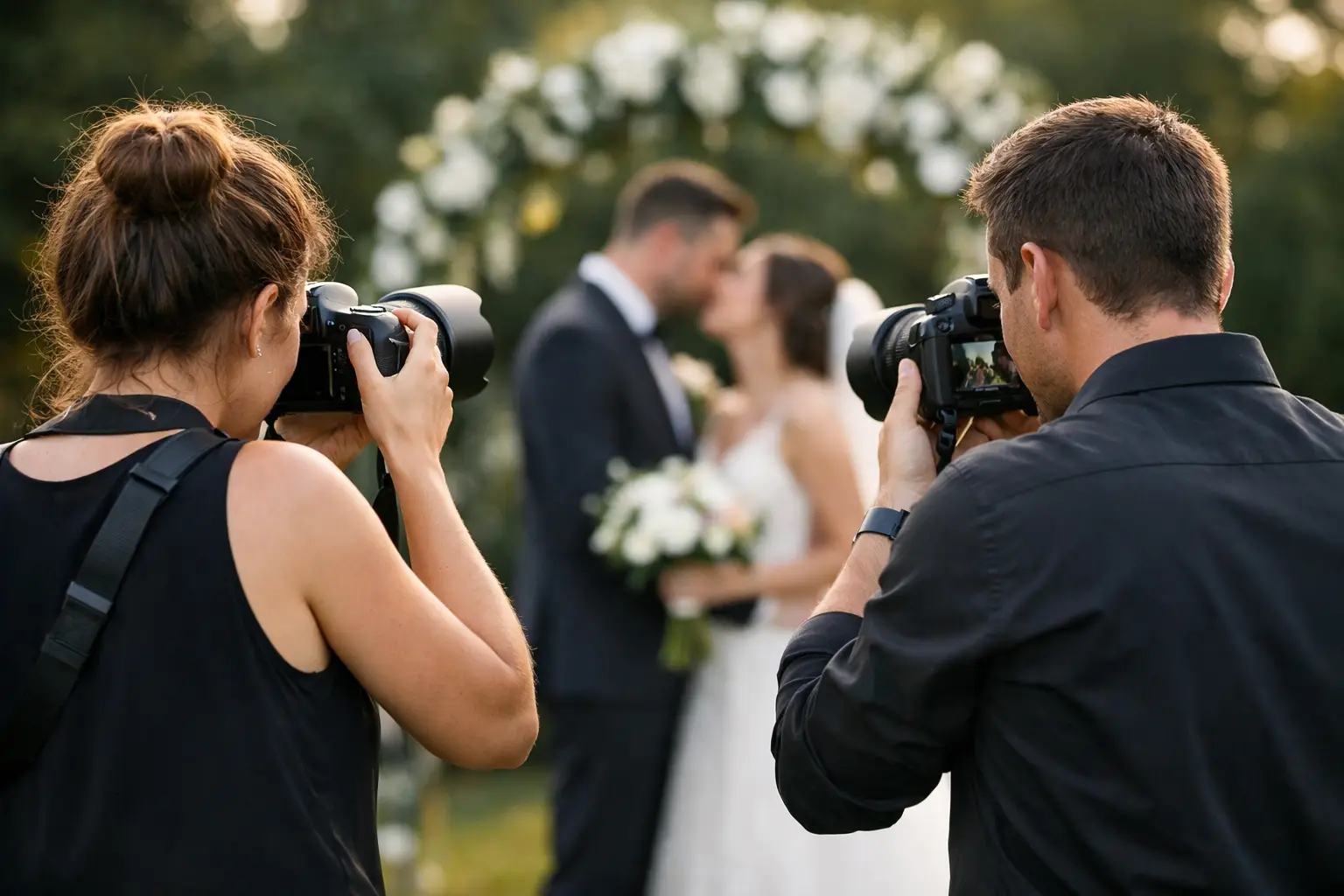
The most obvious advantage is simultaneous coverage. While one photographer documents getting ready with one partner, the other can cover the other location. During the ceremony, one can stay focused on the processional and key reactions while the other captures wider room context, guest emotion, and alternate angles. At the reception, one can stay close to the action while the other notices the unscripted moments happening just beyond the dance floor.
That kind of coverage matters most when the timeline is tight, the guest count is large, or the event has meaningful complexity. If you are hosting a formal wedding in Washington, DC, Northern Virginia, or Maryland with multiple locations, a traditional ceremony, and a full reception, a second professional photographer often adds real value. The day moves quickly. You do not get a second chance at first looks, parent reactions, or fleeting interactions between family members.
A strong two-photographer team also helps with storytelling. One photographer can focus on the essential images you know you want, while the other captures atmosphere, transitions, and emotional details that round out the narrative. That is often the difference between a gallery that records a schedule and one that truly feels like your wedding.
Can you have two photographers at your wedding if they are from different companies?
You can, but this is where complications tend to start.
When a lead photographer brings a second shooter from within their own team or network, those photographers usually know how to work together. They understand who takes the lead, how to avoid stepping into each other’s frame, how to maintain a consistent visual approach, and how to move through the day without drawing attention to themselves. That coordination is not a small detail. It directly affects the quality of the final images and the ease of your experience.
When two unrelated photographers are hired separately, the overlap can create friction. Both may feel responsible for key moments. Both may step into the same space. Both may direct people at once. One may prefer a documentary approach while the other interrupts moments to stage them. Even if both are talented, they may not be working toward the same final result.
For couples investing in premium wedding photography, consistency matters. You want a gallery that feels cohesive in tone, composition, and storytelling. That is much easier to achieve when the photographers are working as one coordinated team rather than two independent vendors competing for the same moments.
The difference between a second shooter and a second photographer
These terms are often used interchangeably, but they are not always the same thing.
A second shooter usually works under the direction of the lead photographer. Their role is to support the overall vision, cover alternate angles, and strengthen the completeness of the story. The final gallery is edited and delivered in one consistent style.
A second photographer can sometimes mean an equal creative partner, or simply another professional hired separately. That setup is not automatically a problem, but it does require clarity. Who is leading family portraits? Who has priority during the ceremony? Who is responsible for staying invisible during intimate moments? Who owns the timeline when things run late, as they often do?
The strongest wedding coverage comes from clear leadership. Couples often assume more photographers means better coverage by default. In reality, more people only help when their roles are defined and their approach is aligned.
When two photographers can create problems
There are times when having two photographers at your wedding is not the right choice.
If your wedding is small, intimate, and designed to feel calm and unobtrusive, too many cameras can change the energy of the day. A 40-person celebration in a private dining room does not usually need a large photo team. In a smaller space, extra photographers can feel physically present in a way that pulls attention from the experience itself.
The same is true if one of the photographers is not a professional but intends to shoot extensively. A well-meaning friend or family member can unintentionally block important shots, delay portraits, or distract guests during emotional moments. This becomes especially noticeable during the ceremony, first dance, and family formals.
There is also the matter of venue policy. Some houses of worship and historic venues limit movement or restrict the number of professionals allowed in certain spaces. If you are considering multiple photographers, it is wise to confirm those policies well in advance.
How to decide what is right for your wedding
The better question is not simply can you have two photographers at your wedding. It is what level of coverage will best support your priorities.
If your top priority is comprehensive storytelling, with authentic moments captured from multiple perspectives, two photographers are often worthwhile. If your wedding includes a larger guest list, separate getting-ready locations, cultural traditions, or a fast-moving reception, the added coverage can make a meaningful difference.
If your priority is a more discreet footprint and a quieter visual presence, one experienced lead photographer may be the stronger choice. A seasoned professional with a documentary instinct can often cover a great deal without making the day feel produced.
This is why the planning conversation matters so much. An experienced studio will ask about your timeline, guest count, venue layout, traditions, family dynamics, and what kinds of photographs matter most to you. The recommendation should come from the shape of your celebration, not from a blanket rule.
Questions to ask before agreeing to two photographers
Before you commit, ask how the team works. Will the second photographer be chosen by the studio? Have they worked together before? Who leads portraits and family groupings? How do they divide ceremony coverage? Will the final images be edited in one consistent style?
If one of the photographers is outside the studio you are hiring, ask even more direct questions. Who has final authority during key moments? Is there a contract clause about outside photography? Some professionals place limits on other vendors or guest photographers for good reason. They are trying to protect both the flow of the day and the quality of your final images.
This is also the time to be honest about family expectations. If an uncle loves photography and plans to bring professional gear, it is far better to address that in advance than on the wedding day. Clear boundaries are kind to everyone.
The best version of two-photographer coverage
At its best, two-photographer coverage does not feel like more production. It feels like more of your story is being preserved.
You see the bride taking a breath before walking down the aisle, and at the same time, the groom’s face as he looks up. You see the elegant wide shot of the ballroom, and the small exchange between grandparents at their table. You see the formal portrait you will frame, and the candid laughter just after it.
That is where experience matters. A coordinated team knows when to step forward and when to disappear. They know how to capture emotion without crowding it. They understand that beautiful wedding photography is not about collecting more files. It is about preserving the meaning, atmosphere, and once-in-a-lifetime rhythm of the day with care.
At Rodney Bailey, that is why coverage decisions are tailored to each event rather than treated as standard packages. The right answer is the one that protects your experience while giving your story the depth it deserves.
If you are deciding between one photographer and two, trust the shape of your day more than a rule of thumb. The best coverage is the one that lets you stay fully present while the moments that matter are captured with intention.
Related Posts